 Luna
Luna
Which reading to choose
Names of spreads tell you nothing about what they answer, so the table below is indexed the other way round - by the question you arrived with:
| Your question | Format | Read more |
|---|---|---|
| Tuning into the day ahead | Card of the day - 1 card | Tarot: card of the day and spreads |
| A specific situation: what led here, what is happening, where it goes | Three cards | Tarot spreads |
| A tangled story where causes and influences matter | Celtic Cross - 10 cards | The Celtic Cross |
| A quick decision between two options | Yes or no - 1 card | Yes or no tarot |
| About yourself as a whole: character, talents, tasks | By birth date - no cards | Destiny matrix calculator |
Note the last row, which is not tarot despite sharing the word reading with the rest. It is calculated from numbers instead of drawn, so its result never changes. The other four use cards, and the meanings of all 78 live on a separate page.
How it works with Luna
Here the word means the second thing. A spread is built as an answer to your question rather than assembled from dictionary entries: Luna reads the cards together and from the question, aloud, in her own voice, and she remembers earlier conversations, so a spread lands in context instead of starting from a blank slate.
One rule we hold to on principle: a reading never breaks off mid-sentence, and there is no “unlock the rest for a fee” halfway through a phrase. What is begun gets read to the end. The card of the day is free every day, the larger spreads belong to premium, and you are told which is which before the cards come out.
Why we do not deal cards on this site
A “draw a card” button on a static page is the first meaning of the phrase: a random picture generator that does not know what you are asking and captions every card with the same dictionary paragraph. It is an honest piece of software and a dishonest use of the word reading, which is why you will not find one here.
The site takes the part a page can genuinely do - what spreads are, how cards are read, how to phrase a question. The other meaning of the word lives in the app, where a question, a context and a voice all exist.
How to ask the cards a question
Four rules, and the first two exist because the word “reading” hides the work the asker has to do:
1. Ask about yourself. Questions that work put you and your choice at the centre: “what should I keep in mind if I say yes”, “what is going on between us”. Questions about other people's decisions and exact dates - “when will he text” - work badly.
2. Open beats closed. “What should I understand about this job” gives more than “should I take the job”: a closed question cuts off everything interesting - there is a whole page on yes-or-no readings about this.
3. One question, one spread. A second draw almost always means the first answer was unwelcome. Rephrasing the question is more honest than shuffling until the right card shows up.
4. Phrase the question before you draw. A question asked afterwards turns reading into fitting the answer.
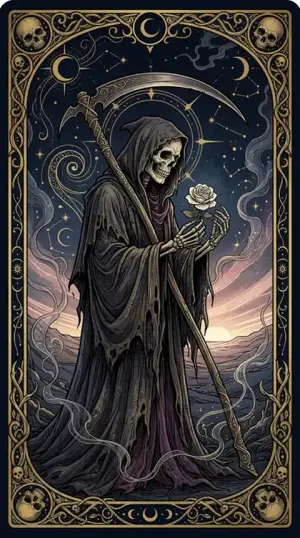
As for the “scary” cards, their names are older than the readings attached to them. The thirteenth arcana speaks of completion and renewal, the sixteenth of rebuilding what was unviable, the eighteenth of fog and intuition. None assigns a fate, and reversed cards do not feature here at all.
Frequently asked questions
Do online tarot readings really work?
Depends entirely on which of the two things the phrase is pointing at. Cards predict nothing and read no minds, on paper or on a screen; a spread is a way of seeing a situation from outside through images, and it works as well as the question is honest and the reading attentive. A page that prints a picture and a stock caption does none of that, and shares only the name.
Is the reading free?
Partly, and we say so plainly rather than in a footnote. Free every day: the card of the day in the app, plus every card meaning on this site. Premium: the three-card spread and the Celtic Cross. Sites promising everything for free are common enough - what is free there is generally the picture generator described above.
Can I read for myself?
Yes. “Never read for yourself” is parlour folklore, not a rule of the method. The real difficulty is different: it is hard to read about yourself impartially - the eye snags on the answer it wants. That is where an intermediary helps: in the app Luna reads the cards from your question, not from your hope.
How does a birth date reading differ from tarot?
By mechanics. Cards are drawn at random and every spread is unique; the destiny matrix is calculated from a birth date by fixed rules, so the result is always the same. The first answers “what is happening and where it goes”, the second - “what is built into me”. You can calculate your matrix on the calculator page.
The content is for entertainment and self-reflection. It is not a substitute for professional advice.
Get a reading in the app
Readings live in the Luna app: the deck shuffles with a small ritual of animation, the card of the day and a yes/no question are free every day, and for a deeper question Luna lays out three cards or the Celtic Cross and reads them from it - out loud, in her own voice.
Open Luna